En une phrase
Un bon modèle de langage est aujourd'hui un bien commun — la question n'est plus si une IA répond, mais avec quel soin. C'est précisément là, dans les prétendus détails, que naît la différence entre « ça semble plausible » et « ça résiste à l'examen ».
Le même modèle, un autre résultat
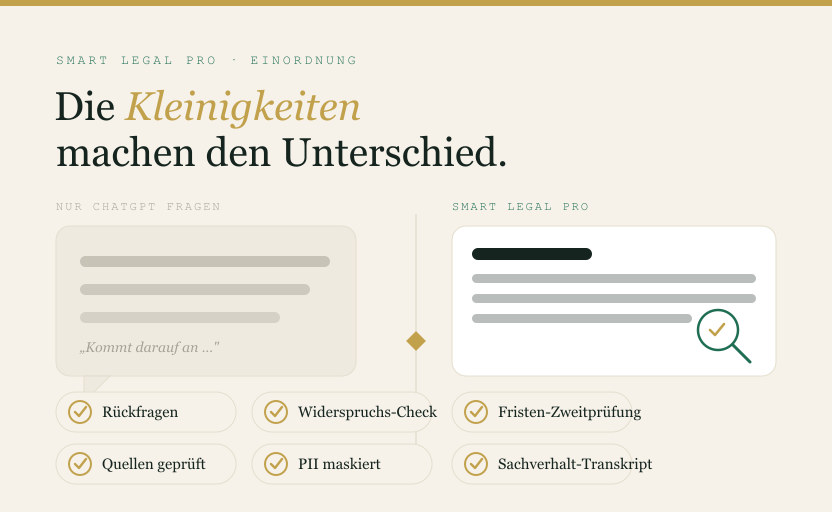
Smart Legal Pro s'appuie sur la même génération de grands modèles de langage que celle que vous connaissez de ChatGPT. Et pourtant, vous obtenez un résultat différent — parce qu'autour du modèle se trouve un savoir-faire juridique qu'un simple chat n'a pas. Six de ces détails :
1. D'abord questionner, ensuite répondre
Les non-juristes ignorent souvent quelles informations sont décisives. Un simple chat se lance alors joyeusement dans des suppositions. Notre mode guidé inverse la logique : l'IA pose une question après l'autre jusqu'à ce que les faits soient établis — et vous pouvez à tout moment poser vos propres questions (« Qu'est-ce que cela signifie ? », « Pourquoi est-ce important ? ») ou répondre honnêtement « Je ne sais pas ». Ce qui reste flou est signalé comme un point ouvert plutôt qu'inventé.
2. Repérer les contradictions au lieu de les gommer
Vous dites d'abord « le congé est arrivé le 3 », puis « fin avril » — un chat complaisant valide les deux. Notre entretien signale la contradiction et demande une clarification avant qu'un courrier n'en découle. Un détail, un grand effet : un exposé des faits porteur d'une contradiction interne ne tient devant aucune administration ni aucun tribunal.
3. Traçabilité : les faits avec un justificatif
De l'entretien naît un exposé des faits soigné — avec transcription. Vous voyez (et pouvez partager avec votre avocate ou votre avocat) comment les faits ont été recueillis, y compris les endroits où vous étiez incertain. Un historique de chat est éphémère ; ici, la démarche fait partie du résultat.
4. Des sources qui existent vraiment
Les modèles de langage adorent inventer des références de décisions et des articles de loi. Nous distinguons clairement : les réponses standard n'inventent aucune décision, et, sur demande, nous ajoutons des sources primaires vérifiées — chaque lien est contrôlé quant à son accessibilité, souvent avec une capture d'archive. Si la recherche échoue, le supplément vous est automatiquement remboursé.
5. Vos données restent vos données
Avant qu'un texte ne parte vers un modèle, nous masquons les données personnelles (noms, adresses, numéros de dossier) et ne les réinsérons que dans le résultat final. Dans une fenêtre de chat ouverte, en revanche, les données de vos clients atterrissent sans protection chez le prestataire.
6. Le droit n'est pas partout le même
Allemagne, Autriche, Suisse — et d'autres — diffèrent par les délais, les normes et les formulations. Grâce à des playbooks et à un cadre juridique défini, l'IA dispose de la bonne base au lieu d'un vague mélange « germanophone ». Un simple détail comme un délai erroné peut coûter toute l'affaire — c'est pourquoi, sur les points critiques, s'ajoute une double vérification des délais.
Rester honnêtes : nous aussi sommes une IA
Pour éviter tout malentendu : Smart Legal Pro est un outil d'analyse et de rédaction, pas un avocat, et ne remplace pas l'examen par un professionnel du droit. Le propos n'est pas « l'IA c'est bien, le chat c'est mal ». Le propos, c'est la rigueur : la même technologie, mais avec des questions de suivi, un contrôle des sources, la protection des données et la traçabilité — les détails qui, en droit, n'en sont justement pas. Notre point de vue à ce sujet est exposé dans Pourquoi pas simplement ChatGPT ? et sur la page Transparence sur l'IA.
Le plus rapide pour se convaincre, c'est la comparaison directe : posez votre prochaine question une fois dans le mode guidé des questions juridiques — et une fois dans un simple chat.