The problem with "generic" legal AI
A great many AI tools generate a contract or a letter and tack a disclaimer onto the end: "please have this adapted for your specific country." That's the honest option — and a useless one, because that's exactly the work the tool was supposed to take off your hands in the first place.
What we did
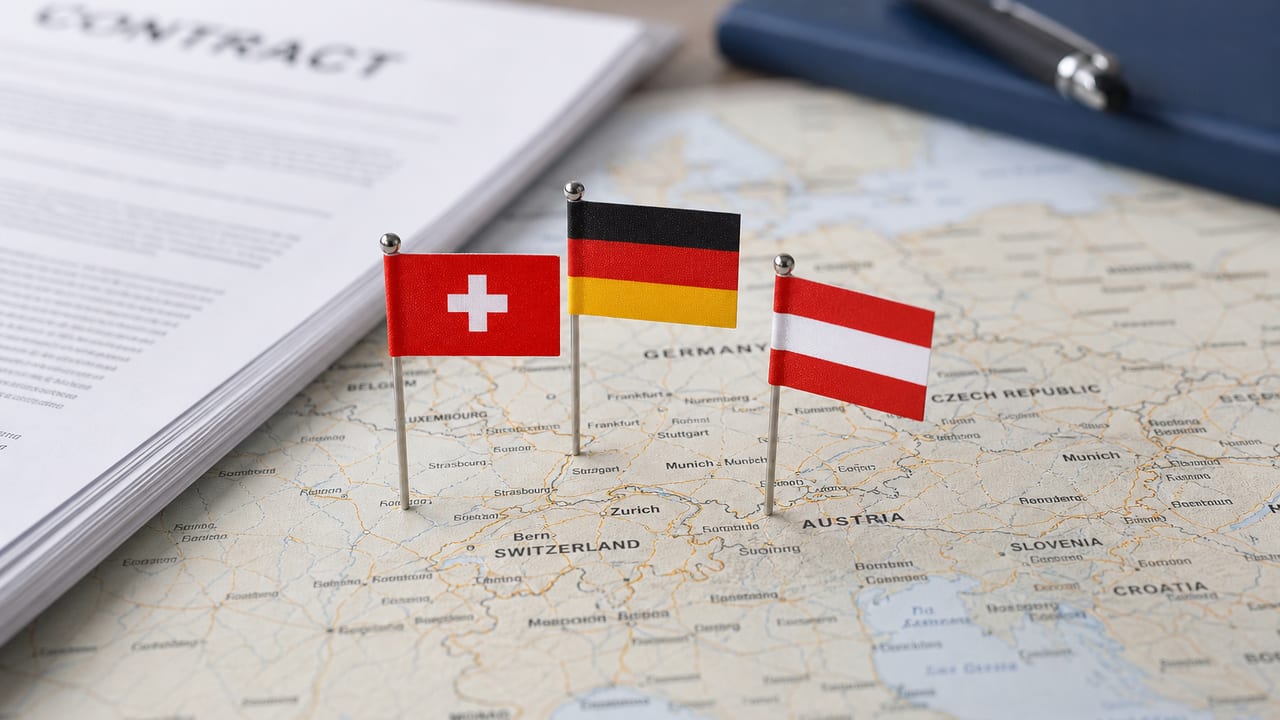
We built our playbooks — the knowledge and rules layer behind every AI generation — separately per country. For the most important contract types (terms and conditions/AGB, NDAs, employment contracts, data processing agreements, service and sales contracts), there are dedicated entries for Germany, Austria and Switzerland, each with the provisions, deadlines and typical risks that actually apply.
A few examples of what that means in concrete terms:
- Terms and conditions (AGB): Germany checks Sections 305–310 BGB (content review, prohibited clauses) and Article 246a EGBGB (consumer information). Austria checks Section 864a ABGB (scope review), Section 6 KSchG, and the FAGG. Switzerland checks Articles 1 and 5 OR (consensus), Articles 40a–g OR (right of withdrawal for doorstep transactions) — and, since September 2023, the revised Data Protection Act (DSG). The same question — "are my terms clean?" — has three very different answers in three countries.
- Employment contracts: since the 2022 Nachweisgesetz (Documentation Act), Germany requires a strict list of mandatory details; Austria applies the AngG plus the ABGB foundations; Switzerland applies Articles 319–362 OR plus the ArG, with its own rules on probationary periods and notice periods (Article 335c OR, blocked periods under Article 336c OR).
- Data processing agreements (AVV): Germany and Austria follow Article 28 GDPR. Switzerland has had its own regime under the revised Data Protection Act (nDSG) since September 2023, with its own requirements.
Why this is more than a handful of section numbers
The playbooks steer three things at the same time:
- The system prompt of the generating AI — it knows not to cite the German Civil Code (BGB) for Switzerland.
- The red-flag list of the document analysis — what's a red flag in Germany (a missing calibration certificate in a fine notice) isn't one in Austria.
- The "next steps" guidance — limitation, objection and filing deadlines differ.
What this means for you
You choose country and language at the start. Everything downstream — generation, analysis, recommendations — adapts accordingly. For cross-border matters (e.g. a Swiss customer with a German supplier), we recognise the cross-border character and take both legal systems into account.
What we don't have yet
Other DACH neighbours (Liechtenstein, Luxembourg) are covered by the XX fallback — meaning we use country-neutral guidance rather than inventing something "specifically wrong". If you need coverage for another country, let us know via the feedback form — we prioritise by demand.