Your documents stay yours.
We treat legal documents with the same care as a law firm. Here is how.
No credit card · 10 credits free · Cancel anytime
Legal documents are rarely harmless: a lease, a cease-and-desist letter, a termination notice. That is why we treat them with the same care as a law firm — technically and organizationally. Data and database sit in the EU, transport is secured with TLS, storage is encrypted with AES-256, and every database query from the app is filtered to your account and your shares through row-level security.
Just as important is what does not happen: your texts are used only to answer your request, never for model training. Personal data patterns are replaced with placeholders before most AI calls and restored only in the response. And you stay in control: you handle access, correction and deletion requests yourself in your account settings at any time; for lawyer accounts we agree the deletion with you because of retention duties.
- The chat stays with your matter
- Re-check without uploading everything again
- You can export everything at any time
Where your data lives
Storage location, transport and separation are the three questions that come before any feature. We answer them here, before you upload your first document.
EU hosting
Data and database in the EU. No transfers to unsafe third countries.
Encryption
TLS in transit and AES-256 at rest for database and file storage.
Isolated documents
Documents sit in separate folders per account. You and the people you share with (firm team, client portal) have access. There is no end-to-end encryption; data is encrypted in transit and at rest.
Who is allowed to see it
Access here is a rule in the database and applies to every query from the app. Server-side services with special privileges are limited to what is necessary and described in the DPA. Which further rights you have, and how to exercise them, is set out in the privacy policy.
Two-factor sign-in is available for administrators and as an optional two-factor sign-in for lawyer accounts (firms can require it).
Row-level security
Every table is protected with RLS — each request from the app is filtered to your account and the access you have granted.
GDPR-compliant
Access, correction, export and deletion requests in your account settings; for lawyer accounts we agree the deletion with you because of retention duties.
This check never leaves your browser
Before a document is uploaded at all, the platform checks its format and size — locally, on your device. Pick any file: you get the same result you would see later in the product, without the file being transmitted anywhere.
It is the same validation code every upload path on the platform uses — not a simplified demo replica.
Upload check
Format, size and estimated text volume — instantly and locally.
The file stays on your device. It is not uploaded and its content is not read — only the file name, size and format are evaluated.
Nothing is sent: the check runs entirely in the browser, with no server request.
No file selected yet. The supported formats and limits are listed below.
Formats and limits
| Supported formats | PDF · DOCX · JPG · JPEG · PNG · WEBP · TXT · MD · MARKDOWN · XML · XLSX · CSV · EML · MSG |
|---|---|
| Maximum file size | 25 MB |
| Not supported: .doc | Word 97–2003 (.doc) is a binary container the text extraction cannot read. We deliberately reject such files instead of charging for an analysis of unreadable content. Save the document as .docx or PDF instead. |
| Not supported: HEIC/HEIF | Apple's photo format is not read reliably everywhere. In the iPhone camera settings you can switch the format to most compatible, which produces JPG files. |
The check covers format and size. Whether a document can actually be evaluated — a scan with legible text, for instance — only becomes clear during text extraction.
How personal details are recognized before they reach a model
Further down you can see how the platform handles personal details. The rule-based core of this recognition — names, account data, contact and other details — you can try right here: it runs entirely in your browser, without the text being sent anywhere.
This preview deliberately shows only a slice: without an actual case file it lacks the names already known there, and the additional model cross-check on already-masked text does not run here.
Live pattern recognition
Type a text or use the example — detection runs instantly, locally.
The text stays on your device. There is no network call — not even when you click “Insert example text”.
Loading…
This preview uses the platform's rule-based core (names, account data, contact and ID details, among others) — without case-specific data and without the additional model cross-check of the full pipeline. The structural recognition is calibrated for German-language phrasing; it recognizes IBANs, email addresses and internationally formatted phone numbers regardless of language. Use it for illustration, not to check real client documents.
Commitments
What we do not do
No AI training
Your texts are used only to answer your request, not for model training.
PII masking
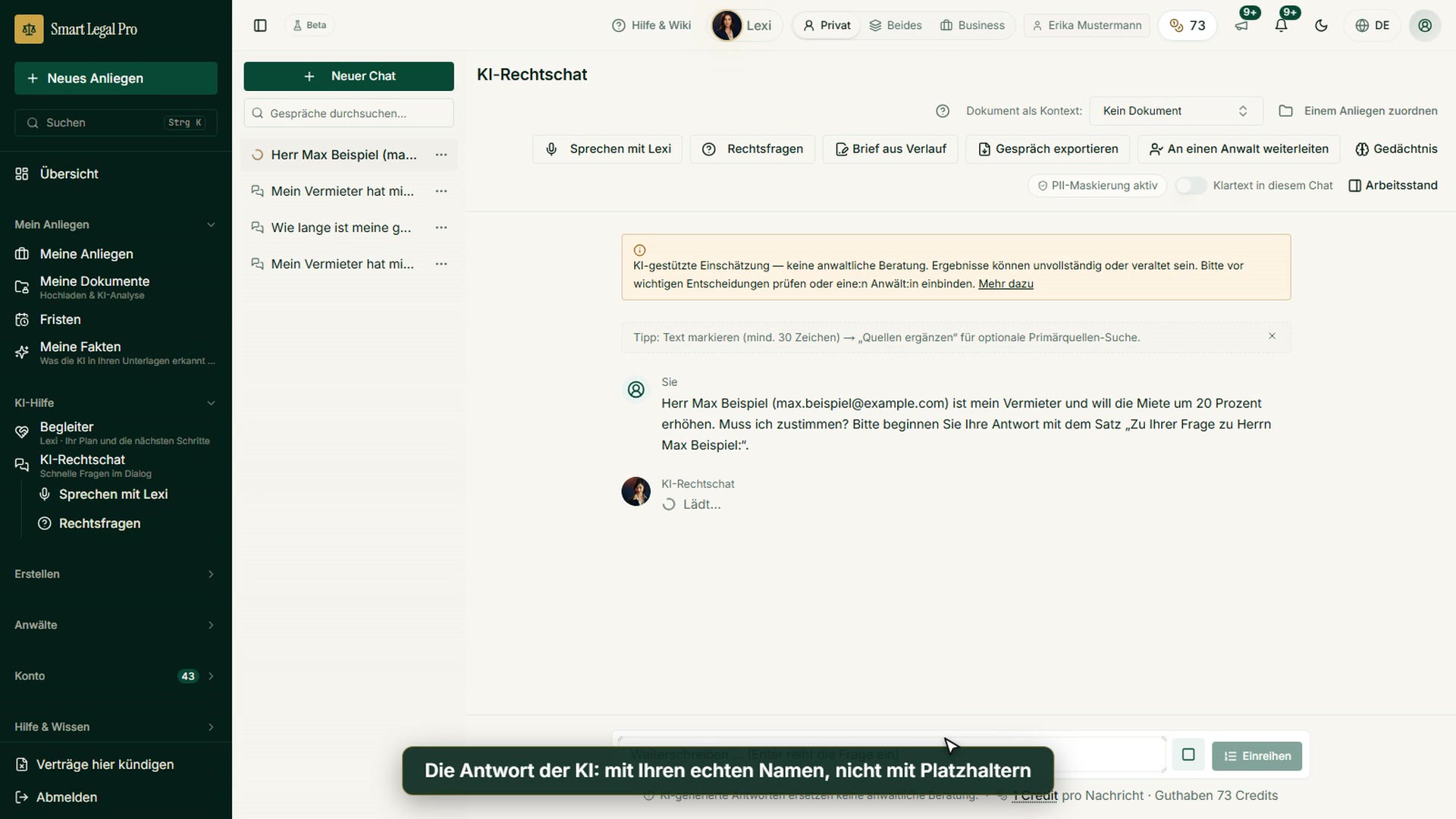
Personal data patterns are replaced with placeholders at the edge and restored in the response. In the consumer area this is the default; in the lawyer portal a firm-level switch governs it (default “standard”), applying to the agents named for it — with documented exceptions where clear names are essential (details: privacy policy §4c, §4g, §4h).
AI model region
AI processing in EU data centers under a data processing agreement: Requesty (EU endpoint) as the gateway to models on Google Vertex AI EU or AWS Bedrock Frankfurt, with a contractual no-training clause. Per the DPA, zero retention applies to the Requesty gateway, not blanket to every provider; text recognition (Mistral), translation (Microsoft Azure, EU) and research services are separate subprocessors. All of them are listed in the subprocessor list.
Professional secrecy
We act as a service provider contributing to your professional practice (§ 203(3) sentence 2 StGB) and are bound to confidentiality; a breach is punishable under § 203(4) StGB. Employees and subprocessors are contractually bound to confidentiality (DPA, § 43e BRAO). The provisions cited apply to Germany.
Read the details
The underlying documents
Multilingual by design
Done means translated and explained
A feature only counts as done when its texts exist in all seven languages and the help center explains it. We treat a gap in any language as a bug.

Questions about security or DPA?
We answer technical and privacy questions personally.