In a nutshell
A good language model is common property today — the question is no longer whether an AI answers, but how carefully. It is precisely there, in the supposed little things, that the difference arises between "sounds plausible" and "stands up to scrutiny".
Similar models, a different result
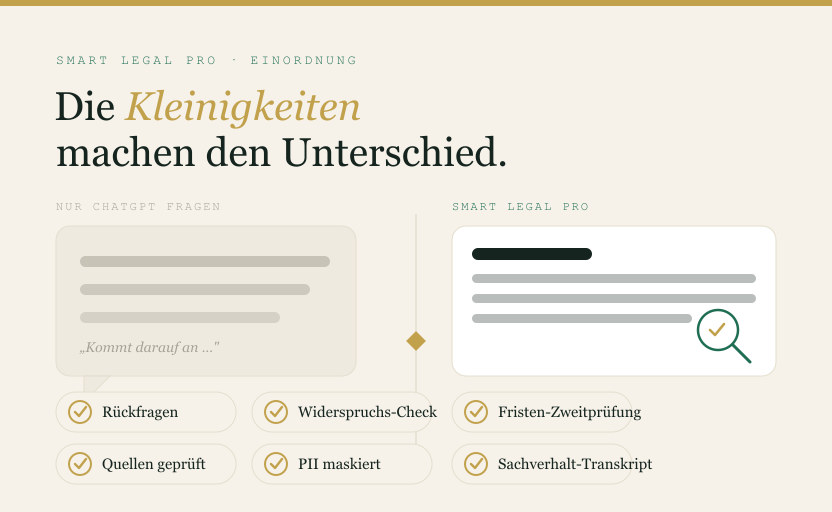
Smart Legal Pro uses language models of the same performance class that also power general AI chats. Even so, the result can be different — because around the model lies a legal craft that a general chat typically does not bring with it. Features differ from provider to provider; the comparison describes the product category, not a specific product. Six of these little things:
1. Ask first, then answer
Non-lawyers often don't know which details are decisive. A general chat then typically answers based on what you have written. Our Guided Mode turns this around: the AI asks one follow-up question after another until the facts are settled — and you can ask back at any time ("What does that mean?", "Why does that matter?") or honestly answer "I don't know". Whatever remains unclear is flagged as an open point rather than invented.
2. Spot contradictions instead of smoothing them over
Say first "the notice arrived on the 3rd", then "at the end of April" — a chat is not built to notice that. Our interview flags the contradiction and asks for clarification before it turns into a document. A little thing with a big effect: a set of facts with an internal contradiction won't hold up before any authority or any court.
3. Traceability: the facts, with a receipt
The interview produces a clean set of facts — with a transcript. You can see (and share with your lawyer) how the facts were gathered, including the points where you were unsure. A chat history is not a structured set of facts; here the derivation is part of the result.
4. Sources that really exist
Language models can reproduce case references and statutory sections incorrectly or phrase them freely. We keep a clear separation: standard answers do not rely on a live web search, and on request we add primary sources — every link is checked for availability, often with an archive snapshot. If the research fails, you automatically get the surcharge back.
5. Your data stays your data
Before any text goes to a model, we mask personal data (names, addresses, case numbers) as far as it is detected, and only reinsert it in the finished output. With a general AI chat, where your input is processed depends on the provider and the plan — clarify that before you enter client data.
6. The law isn't the same everywhere
Germany, Austria, Switzerland — and more — differ in deadlines, statutes and wording. Through playbooks and a fixed legal framework, the AI gets the right basis instead of a vague "German-language" blend. Something as small as a wrong deadline can cost the entire case — which is why, for critical points, there is also a deadline double-check.
Staying honest: we are AI too
So that no false impression arises: Smart Legal Pro is an analysis and writing tool, not a lawyer, and it does not replace a lawyer's review. The point is not "AI good, chat bad". The point is diligence: the same technology, but with follow-up questions, source control, data protection and traceability — the little things that, in the law, are anything but little. How we see this is set out under General AI chat or legal AI? and on the AI transparency page.
The quickest way to be convinced is a direct comparison: ask your next question once in the Guided Mode for legal questions — and once in a general AI chat of your choice.